BPC-157 for Gut Healing & Intestinal Permeability
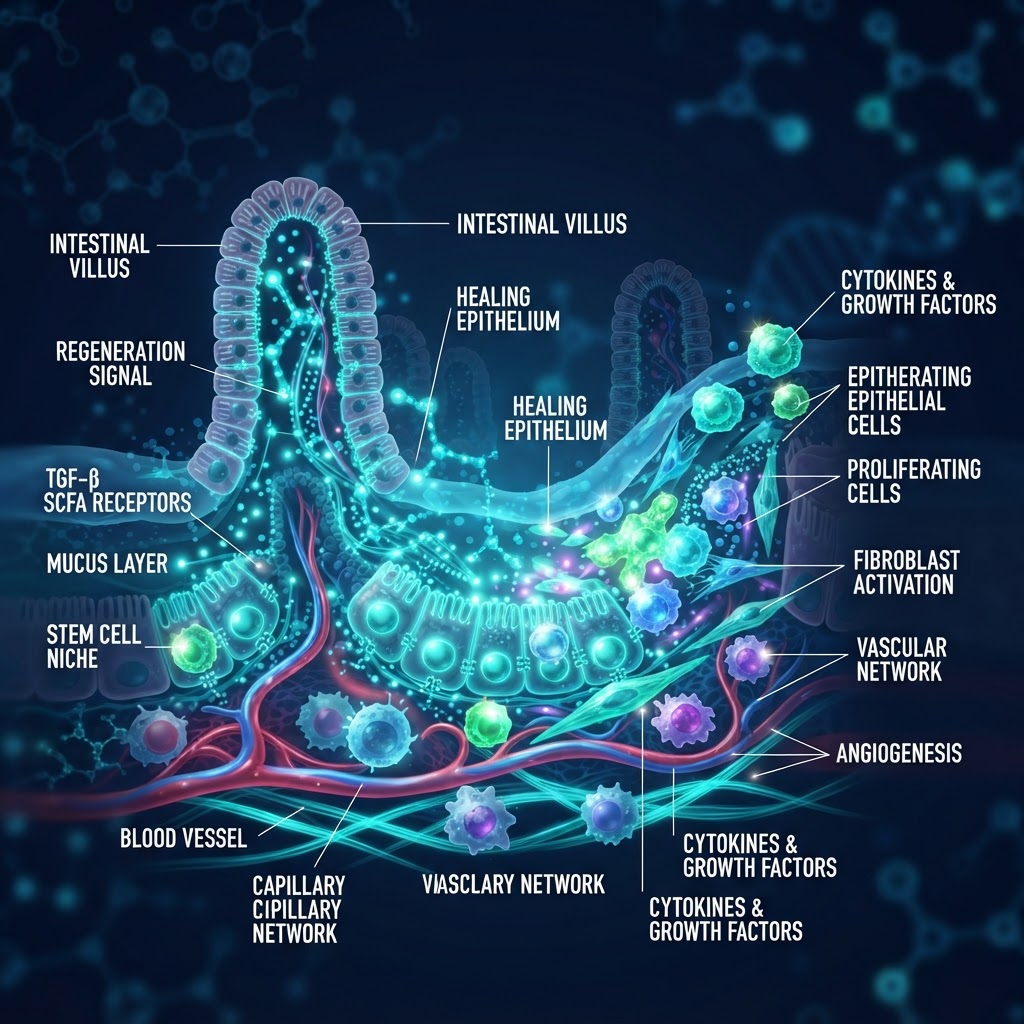
Table of Contents
- 01Could a 15-Amino-Acid Peptide Hold the Key to Gastrointestinal Repair?
- 02What Is BPC-157?
- 03How Does BPC-157 Work? Key Mechanisms in Gut Healing
- 04What the Research Says: BPC-157 & Intestinal Permeability Studies
- 05Research Protocols & Dosing Notes in Preclinical Models
- 06Conclusion: BPC-157 as a Research Tool for GI Science
Could a 15-Amino-Acid Peptide Hold the Key to Gastrointestinal Repair?
The global burden of gastrointestinal disorders — from inflammatory bowel disease to increased intestinal permeability — continues to challenge researchers worldwide. Yet tucked within the naturally occurring proteins of human gastric juice lies a peptide sequence that has produced some of the most compelling GI-repair data in modern peptide science. BPC-157 gut healing research has accelerated dramatically over the past two decades, prompting laboratories across multiple continents to investigate its mechanisms, efficacy, and translational potential.
For research professionals seeking a deeper understanding of this peptide's gastrointestinal profile, this article synthesizes the current body of evidence — from cellular signaling pathways to in vivo model outcomes — with scientific rigor and precision.
What Is BPC-157?
Body Protection Compound-157, commonly abbreviated as BPC-157, is a synthetic pentadecapeptide derived from a cytoprotective protein found in human gastric juice. Its amino acid sequence — Gly-Glu-Pro-Pro-Pro-Gly-Lys-Pro-Ala-Asp-Asp-Ala-Gly-Leu-Val — was first isolated and characterized by researchers at the University of Zagreb in the early 1990s. Unlike many endogenous peptides, BPC-157 demonstrates remarkable stability in biological environments, including resistance to enzymatic degradation in gastrointestinal fluids — a property that makes it particularly relevant for GI tract research.
BPC-157 is classified as a stable gastric pentadecapeptide and has no known toxicity at research doses in animal models. Its structural stability allows it to exert localized effects throughout the gastrointestinal tract, from the esophagus to the colon, making it a uniquely versatile subject for gut-focused studies.
How Does BPC-157 Work? Key Mechanisms in Gut Healing
The mechanistic landscape of BPC-157 gut healing research is multifaceted. Several interconnected pathways have been identified that collectively support intestinal tissue regeneration and barrier function restoration:
- Upregulation of Growth Factors: BPC-157 has been shown to modulate vascular endothelial growth factor (VEGF) and epidermal growth factor receptor (EGFR) signaling. Enhanced angiogenesis — the formation of new blood vessels — accelerates nutrient and oxygen delivery to damaged mucosal tissue, a critical prerequisite for repair.
- Tight Junction Protein Stabilization: Intestinal permeability is regulated largely by tight junction complexes including claudins, occludin, and zonula occludens-1 (ZO-1). Research suggests BPC-157 helps preserve and restore these structural proteins, directly addressing the pathophysiology of leaky gut syndrome in experimental models.
- Nitric Oxide (NO) Pathway Modulation: BPC-157 appears to interact with the nitric oxide system, influencing endothelial function and mucosal blood flow. This interaction is thought to underpin much of its cytoprotective activity in gastric and intestinal tissues.
- Anti-Inflammatory Signaling: Studies in rodent models have documented BPC-157-associated downregulation of pro-inflammatory cytokines including TNF-α, IL-6, and NF-κB activation — key mediators of intestinal inflammation seen in conditions like Crohn's disease and ulcerative colitis.
- Fibroblast Activation & Collagen Synthesis: BPC-157 promotes fibroblast migration and proliferation at wound sites, accelerating collagen deposition that is essential for mucosal remodeling and structural integrity restoration.
Together, these mechanisms create a multi-pronged biological response that makes BPC-157 one of the most pharmacologically interesting peptides currently under investigation for gastrointestinal applications.
What the Research Says: BPC-157 & Intestinal Permeability Studies
The preclinical evidence base for BPC-157 gut healing is substantial and continues to expand. Below is a synthesis of key findings from peer-reviewed animal studies:
- Inflammatory Bowel Disease Models: In rat models of TNBS-induced colitis — a well-validated surrogate for Crohn's disease — BPC-157 administration was associated with significant reductions in macroscopic and microscopic lesion scores, preservation of colonic architecture, and decreased inflammatory infiltrates. Researchers noted normalization of oxidative stress markers in treated animals.
- Gastric Ulcer & Fistula Models: Multiple studies have demonstrated BPC-157's capacity to accelerate gastric ulcer closure in rodent models. In esophago-gastric fistula research, BPC-157 promoted healing of refractory lesions that did not respond to standard interventions — a finding with potentially significant translational implications.
- Intestinal Anastomosis Studies: Research published in surgical journals has shown that BPC-157 improves healing outcomes in intestinal anastomosis models, reducing dehiscence rates and improving tensile strength at surgical repair sites.
- Short Bowel Syndrome Models: In rodents subjected to massive small bowel resection, BPC-157 demonstrated the capacity to enhance adaptive mucosal hypertrophy, potentially offering a research avenue for conditions characterized by reduced absorptive surface area.
- Permeability Marker Studies: Using FITC-dextran assays — a gold-standard method for quantifying intestinal permeability — studies have observed BPC-157-associated reductions in paracellular flux, directly correlating with improved tight junction integrity.
It is important to note that while these preclinical findings are compelling, BPC-157 research has not yet progressed to large-scale human clinical trials. The existing data, while promising, must be interpreted within the context of animal model limitations and the inherent challenges of translational biology.
Research Protocols & Dosing Notes in Preclinical Models
For research professionals designing BPC-157 experimental protocols, understanding the dosing parameters used in published studies provides essential context for replication and methodological alignment.
- Dose Ranges in Rodent Studies: The majority of published studies have employed doses ranging from 1 µg/kg to 10 µg/kg in rat models, with some studies exploring up to 100 µg/kg. Dose-response relationships have been examined, with many researchers reporting efficacy at lower microgram-per-kilogram ranges.
- Administration Routes: Both intraperitoneal (IP) and oral/intragastric routes have been utilized. Notably, BPC-157's stability in gastric acid renders it suitable for oral administration in research models — a relatively rare property among bioactive peptides and one that underscores its relevance to GI research specifically.
- Treatment Duration: Study durations vary widely depending on the model, ranging from acute single-dose experiments to chronic administration periods of 14–30 days in colitis and ulcer healing models.
- Vehicle & Reconstitution: BPC-157 is typically dissolved in sterile saline or acidified water for research use. Proper reconstitution, sterile filtration, and cold storage are essential for maintaining peptide integrity across experimental timelines.
- Outcome Measures: Well-designed BPC-157 gut healing studies routinely incorporate histopathological scoring, cytokine profiling (ELISA), tight junction protein immunohistochemistry, and permeability assays to build a comprehensive mechanistic picture.
Researchers are encouraged to consult the primary literature from Sikiric et al. and affiliated research groups, whose body of work represents the most extensive published dataset on BPC-157 in gastrointestinal models.
Conclusion: BPC-157 as a Research Tool for GI Science
The convergence of mechanistic plausibility, structural stability, and a growing body of preclinical evidence positions BPC-157 gut healing research at the forefront of peptide-based gastrointestinal science. From tight junction preservation and angiogenic stimulation to anti-inflammatory signaling and mucosal remodeling, BPC-157 engages multiple repair pathways simultaneously — a characteristic that distinguishes it from more narrowly acting compounds.
For research institutions focused on GI pathophysiology, intestinal permeability mechanisms, or regenerative medicine, BPC-157 represents a scientifically compelling subject with a well-documented preclinical profile. As the field advances toward more rigorous translational studies, ensuring access to high-purity, properly characterized research-grade peptides will be fundamental to generating reproducible, publication-quality data.
Biologix Supply is committed to supporting the scientific community with premium-grade research peptides, comprehensive certificates of analysis, and the quality assurance infrastructure that serious research demands.
Disclaimer: All products offered by Biologix Supply are strictly for laboratory and research purposes only. They are not intended for human consumption, veterinary use, or any application outside of controlled scientific research environments. This content is intended for research professionals and does not constitute medical advice.
Biologix Supply Research Team
Expert research team specializing in peptide science and longevity compounds.