GHK-Cu Skin Regeneration: Science & Research Insights
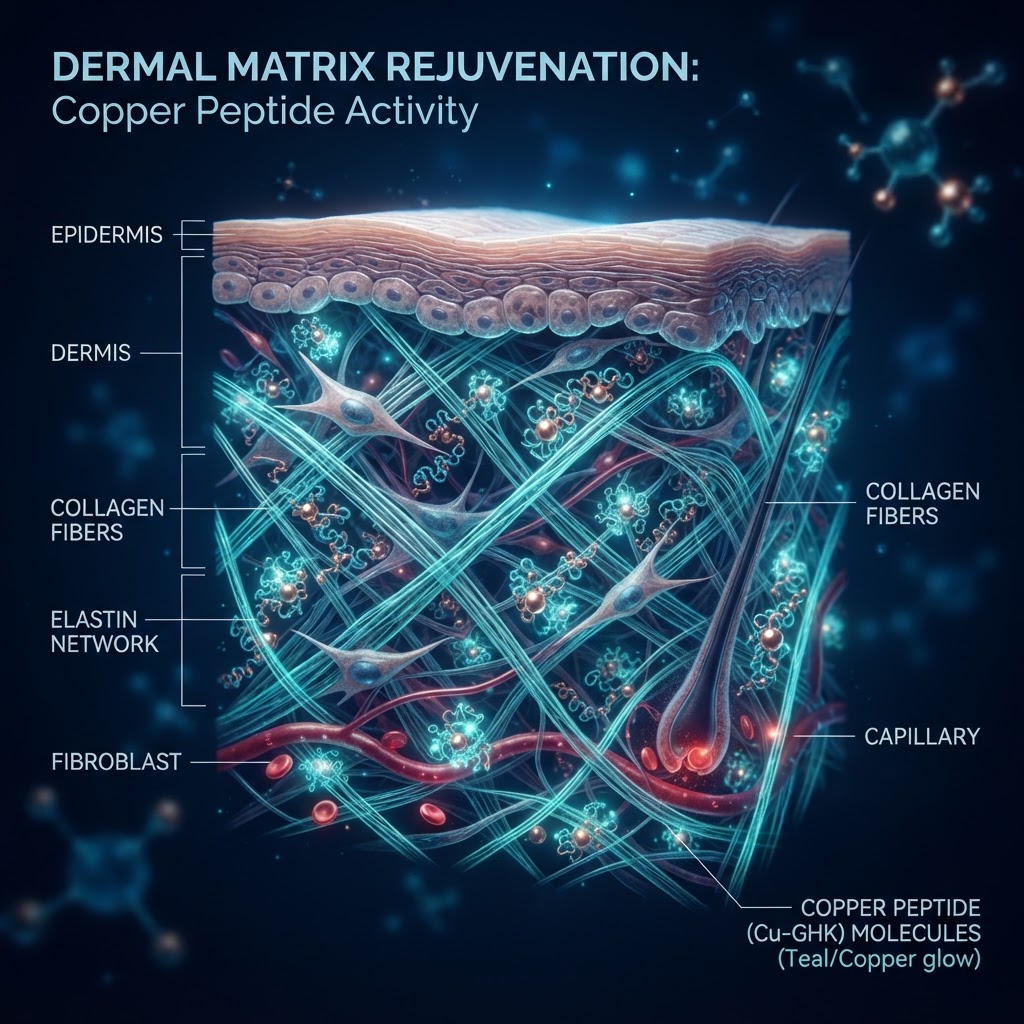
Table of Contents
Could a Three-Amino-Acid Peptide Hold the Key to Advanced Skin Regeneration?
In the landscape of regenerative biology, few compounds have generated as much scientific interest as GHK-Cu — a naturally occurring copper-binding tripeptide first isolated from human plasma in 1973 by Dr. Loren Pickart. What began as an observation that older human plasma caused younger liver tissue to behave "older" led to the discovery of a molecule now recognized for its profound influence on skin regeneration, wound healing, and tissue remodeling. For research professionals exploring the frontier of dermal biology, GHK-Cu represents one of the most compelling and data-rich subjects in the peptide sciences.
What Is GHK-Cu?
GHK-Cu (Glycine-Histidine-Lysine copper complex) is a naturally occurring tripeptide found in human plasma, saliva, and urine. It consists of three amino acids — glycine, histidine, and lysine — bound to a copper (II) ion, which is critical to its biological activity. Copper itself is an essential trace mineral involved in numerous enzymatic processes, and its chelation to the GHK sequence dramatically enhances the peptide's bioavailability and receptor affinity in tissue environments.
Endogenous concentrations of GHK-Cu in human plasma are highest in early life (approximately 200 ng/mL in young adults) and decline significantly with age — a pattern that has led researchers to investigate whether its supplementation in research models can recapitulate youthful tissue dynamics. This age-dependent decline correlates with decreased skin elasticity, slower wound repair, and reduced collagen density, making GHK-Cu skin regeneration research particularly relevant to the anti-aging and longevity research communities.
How Does GHK-Cu Work?
The mechanisms by which GHK-Cu exerts its effects are multifaceted and operate across several interlocking biological pathways. Understanding these mechanisms is essential for any research professional designing experiments around this peptide.
- Collagen and Elastin Synthesis: GHK-Cu has been shown in cell culture studies to upregulate the production of collagen types I, III, and VI, as well as elastin and proteoglycans like decorin and versican. These are foundational extracellular matrix (ECM) proteins responsible for skin tensile strength and elasticity. Simultaneously, GHK-Cu modulates matrix metalloproteinases (MMPs) — enzymes that degrade old collagen — promoting a balanced remodeling environment rather than net ECM breakdown.
- Angiogenesis and Wound Vascularization: Research indicates that GHK-Cu stimulates vascular endothelial growth factor (VEGF) expression, supporting the formation of new blood vessels (angiogenesis). Adequate vascularization is a critical bottleneck in wound healing, as regenerating tissue requires robust oxygen and nutrient delivery.
- Stem Cell Recruitment and Fibroblast Activation: GHK-Cu appears to attract macrophages and mast cells to wound sites and stimulate fibroblast proliferation and migration — two processes central to the proliferative phase of wound healing. Activated fibroblasts are the primary synthesizers of new ECM components in healing tissue.
- Anti-Inflammatory and Antioxidant Activity: Copper complexed to GHK acts as a superoxide dismutase (SOD) mimetic, neutralizing reactive oxygen species (ROS) that can damage tissue at wound sites. GHK-Cu also downregulates pro-inflammatory cytokines such as TNF-α and IL-6 in experimental models, helping to resolve the inflammatory phase of healing more efficiently.
- Gene Expression Modulation: Perhaps most remarkably, genomic analyses by Pickart and colleagues identified GHK-Cu as a broad regulator of gene expression, influencing over 4,000 human genes — many related to tissue remodeling, DNA repair, and anti-senescence pathways. This genome-wide activity positions GHK-Cu skin regeneration research at the intersection of epigenetics and regenerative medicine.
What the Research Says
The scientific literature on GHK-Cu is extensive for a peptide of its size, spanning in vitro studies, animal models, and controlled dermal application trials. Here are key findings relevant to research professionals:
- Wound Contraction Studies: Early animal model studies demonstrated that topical application of GHK-Cu accelerated wound contraction rates and improved tensile strength in healing skin compared to controls. These foundational findings established the peptide's wound-healing credentials and sparked decades of follow-on research.
- Collagen Density in Aged Tissue: A study published in the Journal of Biomaterials Science found that GHK-Cu applied to aged skin models significantly increased collagen density and dermal thickness, supporting its relevance to GHK-Cu skin regeneration as a counter to chronological aging.
- Anti-Fibrotic Properties: Counterintuitively, while GHK-Cu promotes collagen synthesis in healing wounds, it also inhibits excessive fibrosis and scar formation by modulating TGF-β signaling and promoting normal collagen fiber alignment. This dual regulatory behavior makes it of interest in anti-scarring research contexts.
- Neurotrophin Expression: Research has noted GHK-Cu's capacity to upregulate nerve growth factor (NGF) and brain-derived neurotrophic factor (BDNF), suggesting potential applications in research models of neural wound healing and peripheral nerve regeneration.
- Genomic Safety Profile: Bioinformatic analyses of GHK-Cu's gene regulatory effects show consistent upregulation of DNA repair genes and downregulation of genes associated with inflammation and cellular senescence — a profile of considerable interest to longevity researchers.
It is important to note that while these findings are compelling, the majority of high-quality mechanistic data comes from in vitro and animal model studies. Research professionals should apply rigorous experimental design when translating these findings into novel research contexts.
Research Protocols & Dosing Notes
For laboratory researchers working with GHK-Cu, the following general parameters are drawn from the published literature and are intended purely as reference points for experimental design. These are not clinical dosing recommendations.
- In Vitro Cell Culture Models: GHK-Cu is frequently studied in fibroblast and keratinocyte cultures at concentrations ranging from 1 nM to 10 µM. At nanomolar concentrations, the peptide demonstrates maximal stimulation of collagen synthesis in fibroblast lines, with activity beginning to plateau or exhibit biphasic behavior at higher concentrations depending on the cell type and endpoint measured.
- Topical Research Formulations: In published dermal model studies, GHK-Cu has been incorporated into carrier solutions at concentrations of 0.1% to 2% (w/v), often complexed with liposomal or hydrogel delivery systems to enhance transdermal penetration. Penetration enhancement is a critical variable in topical skin regeneration studies.
- Animal Wound Models: Rodent excisional and incisional wound models have employed subcutaneous or topical administration protocols. Topical application schedules in published studies range from once to twice daily for 7–21 day observational windows, with histological endpoints including collagen density, wound closure rate, and neovascularization scoring.
- Stability Considerations: GHK-Cu in solution is sensitive to oxidation and pH fluctuations. Research-grade preparations should be stored at -20°C, protected from light, and reconstituted in sterile, degassed aqueous vehicles at slightly acidic pH (4.5–6.5) to maintain copper chelation integrity and peptide stability.
- Combination Research Models: Some researchers have examined GHK-Cu in combination with other regenerative agents such as EGF (epidermal growth factor) or retinoids in matrix models, noting potential additive effects on fibroblast activation. Combination studies require careful controls to isolate GHK-Cu-specific contributions.
Conclusion
GHK-Cu stands as one of the most scientifically substantiated peptides in the field of skin regeneration and wound healing research. Its elegant mechanisms — spanning ECM remodeling, angiogenesis, anti-inflammatory signaling, and broad-spectrum gene regulation — make it a uniquely versatile research tool for scientists working in dermal biology, regenerative medicine, and longevity science. The robust body of literature supporting GHK-Cu skin regeneration activity provides a strong framework for novel research hypotheses, and ongoing genomic studies continue to reveal new dimensions of this small peptide's extraordinary biological reach.
For research professionals seeking high-purity, rigorously characterized GHK-Cu for laboratory applications, sourcing from a trusted, quality-assured supplier is paramount. Biologix Supply provides research-grade peptides with verifiable purity data to support your most demanding experimental protocols.
Disclaimer: All products offered by Biologix Supply are intended for laboratory and research purposes only. They are not intended for human consumption, therapeutic use, or veterinary application. All research must be conducted by qualified professionals in compliance with applicable institutional and regulatory guidelines.
Biologix Supply Research Team
Expert research team specializing in peptide science and longevity compounds.