GHK-Cu Skin Regeneration: Wound Healing Research Guide
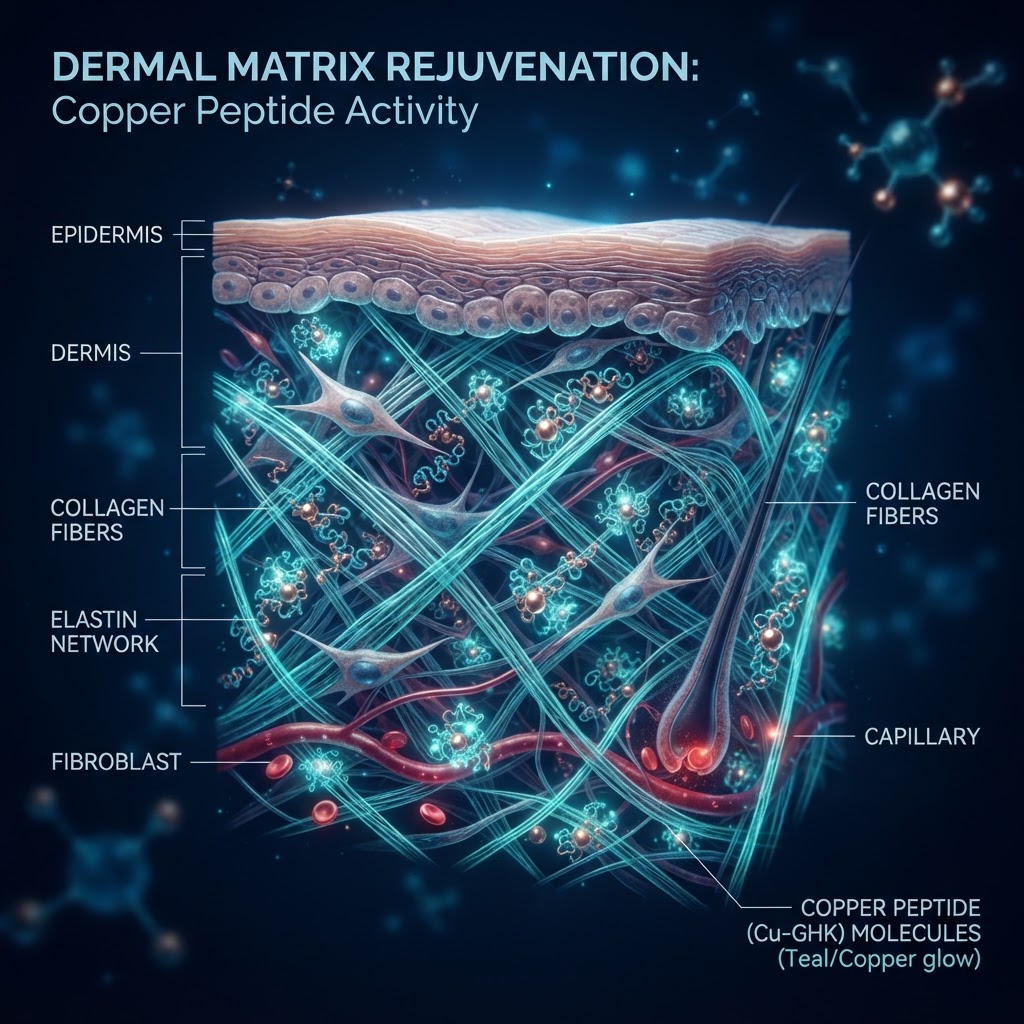
Table of Contents
- 01What If a Tripeptide Could Reprogram Aging Skin at the Genetic Level?
- 02What Is GHK-Cu?
- 03How Does GHK-Cu Work? Key Mechanisms in Skin Regeneration
- 04What the Research Says: Key Studies on GHK-Cu Skin Regeneration
- 05Research Protocols & Dosing Notes
- 06Conclusion: GHK-Cu as a Premier Target in Skin Regeneration Research
What If a Tripeptide Could Reprogram Aging Skin at the Genetic Level?
That's not a speculative question — it's the premise behind more than four decades of peer-reviewed research into GHK-Cu (Glycyl-L-Histidyl-L-Lysine copper complex). Originally isolated from human plasma in 1973 by Dr. Loren Pickart, GHK-Cu has since become one of the most scrutinized molecules in dermatological and regenerative science. Studies suggest it may modulate over 4,000 human genes — roughly one-fifth of the entire genome — with particular relevance to tissue repair, inflammation control, and extracellular matrix remodeling. For research professionals investigating GHK-Cu skin regeneration, the body of evidence is both deep and compelling.
What Is GHK-Cu?
GHK-Cu is a naturally occurring tripeptide-copper complex found in human plasma, saliva, and urine. The peptide portion — glycyl-L-histidyl-L-lysine — has a high binding affinity for copper (II) ions, forming a stable complex that appears to be biologically active in ways that the free peptide and free copper ion are not individually. Endogenous plasma concentrations of GHK are highest in early life (approximately 200 ng/mL at age 20) and decline significantly with age, dropping to around 80 ng/mL by age 60. This age-related decline has led researchers to hypothesize a mechanistic link between falling GHK-Cu levels and the deterioration of skin integrity, wound repair capacity, and systemic regenerative signaling observed in aging populations.
As a research compound, GHK-Cu is typically synthesized as a lyophilized powder and reconstituted for use in in vitro and in vivo experimental models. Its small molecular size (~340 Da) facilitates cellular uptake and enables interaction with a broad array of intracellular targets, making it a uniquely versatile subject for skin biology research.
How Does GHK-Cu Work? Key Mechanisms in Skin Regeneration
The mechanisms underlying GHK-Cu skin regeneration are multifactorial, operating across genomic, proteomic, and cellular levels. Current research has identified several primary pathways of interest:
- Collagen & Elastin Synthesis: GHK-Cu has been shown to stimulate fibroblast production of collagen types I and III, as well as elastin and decorin — core structural proteins responsible for skin tensile strength and elasticity. Concomitantly, it appears to modulate matrix metalloproteinases (MMPs), reducing excessive collagen degradation while preserving normal tissue remodeling balance.
- Angiogenesis Promotion: Adequate wound healing requires robust neovascularization. Research indicates GHK-Cu upregulates vascular endothelial growth factor (VEGF) expression, supporting the formation of new capillary networks essential for nutrient delivery to regenerating tissue.
- Anti-Inflammatory Signaling: GHK-Cu appears to suppress pro-inflammatory cytokines including TNF-α and IL-6, while simultaneously activating antioxidant defense pathways. This dual action may help create an optimal biochemical environment for tissue repair by resolving the inflammatory phase of wound healing more efficiently.
- Stem Cell Activation & Fibroblast Migration: Several studies report that GHK-Cu promotes the migration and proliferation of fibroblasts and keratinocytes into wound sites — a critical early step in re-epithelialization. Research also suggests possible interactions with stem cell niches that accelerate dermal repopulation.
- Gene Expression Remodeling: Perhaps most remarkably, gene array analyses conducted by Pickart and colleagues identified GHK-Cu as a potent modulator of gene transcription, particularly genes associated with DNA repair, anti-apoptotic signaling, and metabolic restoration — collectively described as a shift from a "breakdown" to a "rebuild" genetic program.
What the Research Says: Key Studies on GHK-Cu Skin Regeneration
The scientific literature on GHK-Cu is extensive, spanning decades of both preclinical and translational research. Below are some of the most notable findings relevant to skin regeneration and wound healing:
- Wound Contraction & Healing Rate: Pickart's foundational animal studies demonstrated that topically applied GHK-Cu significantly accelerated wound contraction and closure rates in rodent models, with improvements in both the speed and quality of scar formation compared to untreated controls.
- Collagen Density in Aged Skin: A double-blind, vehicle-controlled study published in dermatology literature reported that topical GHK-Cu formulations significantly increased collagen density, skin thickness, and firmness in subjects with photo-damaged skin — findings that have made GHK-Cu a subject of intense cosmeceutical and pharmaceutical interest.
- Chronic Wound Models: Research in diabetic animal models — where impaired wound healing is a hallmark complication — has shown GHK-Cu treatment to meaningfully improve healing trajectories, potentially through normalization of the oxidative and inflammatory microenvironment that characterizes chronic wounds.
- Antioxidant Defense: Studies have documented GHK-Cu's ability to upregulate superoxide dismutase (SOD) and other endogenous antioxidant enzymes, providing cellular protection against reactive oxygen species (ROS) that otherwise accumulate in aging and traumatized tissue.
- Genomic Studies: A landmark bioinformatic analysis by Pickart and Margolina (2012) evaluated GHK-Cu's effect on gene expression using publicly available datasets, concluding that GHK-Cu activation signatures strongly overlapped with genes controlling DNA repair, mitochondrial function, and inflammatory resolution — supporting its classification as a broad-spectrum regenerative signal.
While the majority of foundational work involves in vitro fibroblast cultures and rodent wound models, the consistency of findings across experimental systems has positioned GHK-Cu skin regeneration as a high-priority area for continued investigation, including translational research aimed at chronic wound care, burn treatment, and dermal aging.
Research Protocols & Dosing Notes
For researchers designing experiments with GHK-Cu, the following general parameters reflect commonly reported approaches in published literature. These are provided strictly as a reference for laboratory research design and do not constitute medical or clinical guidance.
- Common Concentrations (In Vitro): Cell culture studies typically employ GHK-Cu at concentrations ranging from 1 nM to 10 µM, with fibroblast proliferation and collagen synthesis assays often utilizing 1–100 nM ranges to observe dose-dependent effects without cytotoxicity.
- Topical Application Models: Animal wound healing studies have utilized topical formulations containing GHK-Cu at concentrations of 0.1% to 1% (w/v), applied one to two times daily over wound sites. Carrier matrices including hydrogel, saline solution, and emulsion bases have all been reported.
- Reconstitution: Lyophilized GHK-Cu powder is typically reconstituted in sterile bacteriostatic water or phosphate-buffered saline (PBS). Researchers should prepare aliquots to minimize freeze-thaw cycles, which may degrade peptide integrity.
- Storage Conditions: Lyophilized peptide should be stored at -20°C and protected from light. Reconstituted solutions are generally stable for short-term use at 4°C but should be used within 48–72 hours for optimal activity.
- Assay Endpoints: Common outcome measures in skin regeneration research include hydroxyproline content (collagen quantification), wound closure rate (planimetry), histological scoring (H&E and Masson's trichrome), gene expression analysis (qPCR, RNA-seq), and cytokine profiling (ELISA).
Researchers are encouraged to consult the primary literature and establish pilot dose-response studies before committing to larger experimental designs, as optimal concentrations may vary with cell type, species model, and specific research endpoint.
Conclusion: GHK-Cu as a Premier Target in Skin Regeneration Research
Few peptides have demonstrated the breadth of biological activity associated with GHK-Cu skin regeneration research. From fibroblast stimulation and angiogenesis to genome-wide transcriptional reprogramming, GHK-Cu sits at a remarkable convergence of dermatology, aging biology, and regenerative medicine. Its naturally declining levels with age, coupled with a robust mechanistic rationale and decades of supporting preclinical data, make it one of the most scientifically justified peptides for researchers investigating skin repair, wound healing, and anti-aging pathways.
As the field advances toward more sophisticated in vivo models and potential translational applications, high-purity, well-characterized GHK-Cu remains an indispensable research tool. Biologix Supply is committed to providing research-grade peptides that meet the rigorous standards demanded by serious scientific inquiry.
Disclaimer: All products offered by Biologix Supply are intended strictly for laboratory and research purposes only. They are not approved for human consumption, self-administration, veterinary use, or therapeutic application. All research must be conducted by qualified professionals in compliance with applicable institutional and regulatory guidelines.
Biologix Supply Research Team
Expert research team specializing in peptide science and longevity compounds.