Peptide Certificate of Analysis (COA): Why It Matters
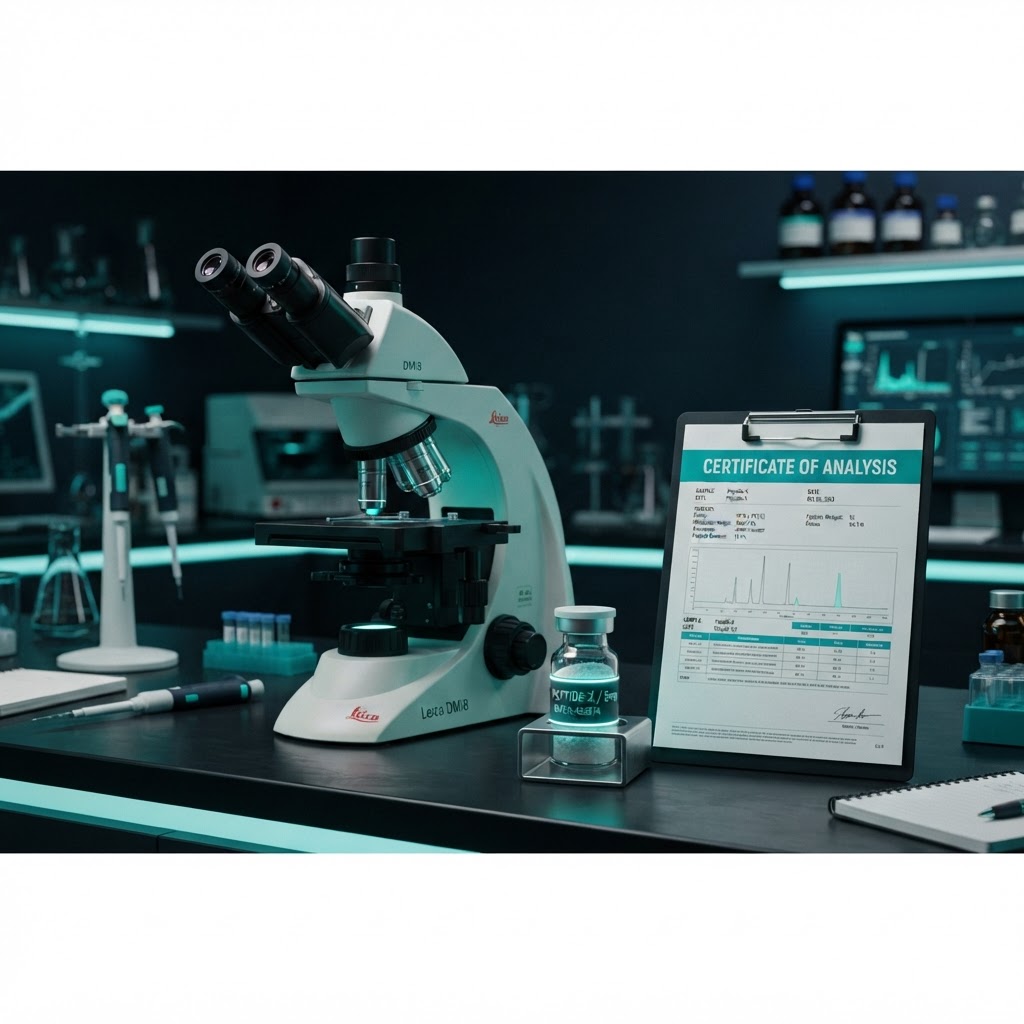
Table of Contents
- 01Would You Use a Compound You Couldn't Verify? Most Researchers Already Are.
- 02What Is a Certificate of Analysis (COA)?
- 03How Does COA Testing Work?
- 04What the Research Says About Peptide Quality Variability
- 05How to Read and Evaluate a Peptide COA
- 06Why Biologix Supply Prioritizes COA Transparency
- 07Conclusion: The COA Is Non-Negotiable
Would You Use a Compound You Couldn't Verify? Most Researchers Already Are.
Studies suggest that a significant portion of research peptides sold online contain impurities, incorrect concentrations, or are outright mislabeled — yet many researchers never think to ask for documentation before they order. If you're conducting serious preclinical or laboratory research, your results are only as trustworthy as the compounds you use. That's where the peptide Certificate of Analysis (COA) becomes not just useful, but absolutely essential.
In this guide, we'll break down exactly what a COA is, what it should contain, how to read one, and why it should be the first thing you look for when sourcing research peptides from any supplier.
What Is a Certificate of Analysis (COA)?
A Certificate of Analysis (COA) is an official document issued by a qualified analytical laboratory that certifies the identity, purity, potency, and quality of a specific compound — in this case, a research peptide. Think of it as the birth certificate and report card of your compound rolled into one.
A legitimate peptide COA is generated after rigorous third-party or in-house analytical testing and should accompany every batch of peptide product sold by a reputable supplier. It is batch-specific, meaning the COA for Lot #A001 reflects the precise test results for that exact production run — not a generic document reused across multiple batches.
Key elements you should expect to see on a complete, trustworthy peptide certificate of analysis COA include:
- Compound Name & Sequence: The full chemical name and amino acid sequence of the peptide, confirming you have what you ordered.
- Lot/Batch Number: A unique identifier linking the COA to a specific production batch for full traceability.
- Purity Percentage (HPLC): Determined via High-Performance Liquid Chromatography, this value indicates what percentage of the material is the target compound. Research-grade peptides should typically exceed 98% purity.
- Molecular Weight Confirmation (Mass Spectrometry): Mass spec data confirms the molecular weight matches the theoretical value for the peptide, verifying structural identity.
- Water Content (Karl Fischer Titration): Measures residual moisture, which affects actual peptide content per milligram.
- Testing Laboratory Name & Accreditation: Identifies who performed the analysis and whether they hold relevant accreditations (e.g., ISO 17025).
- Date of Analysis & Expiration/Retest Date: Establishes when the testing was conducted and the compound's recommended shelf life under proper storage conditions.
How Does COA Testing Work?
Understanding the science behind the tests listed on a peptide COA helps researchers interpret results with confidence rather than simply trusting a number on a page.
High-Performance Liquid Chromatography (HPLC) is the gold standard for peptide purity analysis. A sample is dissolved in a mobile phase and passed through a stationary column under high pressure. Different compounds interact with the column at different rates, causing them to separate. The resulting chromatogram shows distinct peaks — the area under the target peptide's peak relative to all other peaks gives the purity percentage. A clean, single dominant peak with minimal extraneous signals indicates a high-purity compound.
Mass Spectrometry (MS), often run in tandem with HPLC (LC-MS), measures the mass-to-charge ratio of ionized molecules. For peptide identity confirmation, the observed molecular weight from the mass spectrum is compared against the theoretical molecular weight calculated from the amino acid sequence. A match within acceptable tolerance confirms the compound is what it claims to be — not a truncated sequence, oxidized variant, or entirely different molecule.
Karl Fischer Titration is a precise electrochemical method that quantifies trace water content in the peptide sample. Because lyophilized peptides are sold by weight, high water content means less actual peptide per milligram — a critical consideration when preparing accurate stock solutions for research.
What the Research Says About Peptide Quality Variability
The importance of a verifiable peptide certificate of analysis COA isn't theoretical — it's supported by real-world quality assessments. Independent testing of commercially available research peptides has repeatedly revealed substantial variation in purity and identity across different suppliers. Some compounds have been found to contain as little as 70–80% of the stated active ingredient, while others have failed identity testing entirely.
For researchers, this variability introduces a serious confounding variable into experimental design. If you are studying the dose-dependent effects of a peptide on a specific cellular pathway, and your compound is only 85% pure with unknown impurities comprising the remainder, your data may be irreproducible, misleading, or scientifically invalid. Peer-reviewed research depends on the use of characterized, verified compounds — and a robust COA is the primary mechanism by which compound characterization is communicated.
Furthermore, uncharacterized impurities in research peptides can include truncated sequences, racemized amino acids, oxidation byproducts, and residual synthesis reagents — all of which can independently produce biological effects that contaminate your experimental results.
How to Read and Evaluate a Peptide COA
Not all COAs are created equal. Here is a practical framework for evaluating the legitimacy and quality of a peptide certificate of analysis:
- Check the purity value first. For research applications, look for ≥98% purity by HPLC. Anything below 95% should be used with caution and acknowledged as a limitation in any experimental write-up.
- Confirm mass spec identity. The observed molecular weight should match the theoretical molecular weight within ±1 Da or within the instrument's stated tolerance. No mass spec data on the COA is a significant red flag.
- Verify the lot number matches your product. A COA that cannot be linked to a specific batch is a generic marketing document, not a true analytical certificate.
- Look for the testing lab's identity. Reputable suppliers use accredited third-party laboratories. An anonymous "internal" COA with no lab name or contact information warrants skepticism.
- Check the analysis date. COA data should be recent and relevant to the batch you are purchasing. A COA from three years ago on a "new" batch is not valid documentation.
- Look for the HPLC chromatogram. Premium suppliers provide the actual chromatogram image alongside the summary values, allowing experienced researchers to assess peak shape, baseline noise, and the presence of minor impurity peaks directly.
Why Biologix Supply Prioritizes COA Transparency
At Biologix Supply, we believe that research integrity starts before the experiment — it starts at the point of sourcing. Every research peptide in our catalog is accompanied by a full, batch-specific Certificate of Analysis generated by accredited third-party analytical laboratories. Our COAs include HPLC purity data, mass spectrometry identity confirmation, and are linked to individual lot numbers so you can maintain complete traceability throughout your research workflow.
We make our COAs openly accessible because we understand that transparency is not a feature — it's a baseline requirement for any supplier serious about supporting the scientific community. Researchers shouldn't have to ask for documentation; it should be the first thing offered.
Conclusion: The COA Is Non-Negotiable
Whether you are a seasoned pharmacologist, a university research team, or an independent preclinical investigator, the peptide certificate of analysis COA should be a non-negotiable requirement in your compound sourcing checklist. It is the single most important document separating a verified research compound from an uncharacterized unknown.
Before you place your next order, ask yourself: Does this supplier provide a batch-specific COA? Does it include both HPLC purity and mass spectrometry data? Is the testing laboratory identified and credentialed? If the answer to any of these questions is no, the integrity of your research — and the value of your time — may be at risk.
Demand better. Your research deserves compounds you can trust, and at Biologix Supply, every product in our catalog comes with the documentation to prove it.
Disclaimer: All products offered by Biologix Supply are intended for laboratory research and scientific study purposes only. These compounds are not approved for human consumption, veterinary use, or any clinical application. They are not drugs, supplements, or medical treatments. All research must be conducted in compliance with applicable local, state, and federal regulations by qualified professionals in appropriate research settings.
Biologix Supply Research Team
Expert research team specializing in peptide science and longevity compounds.