Peptide Storage Best Practices: Lyophilized vs Liquid
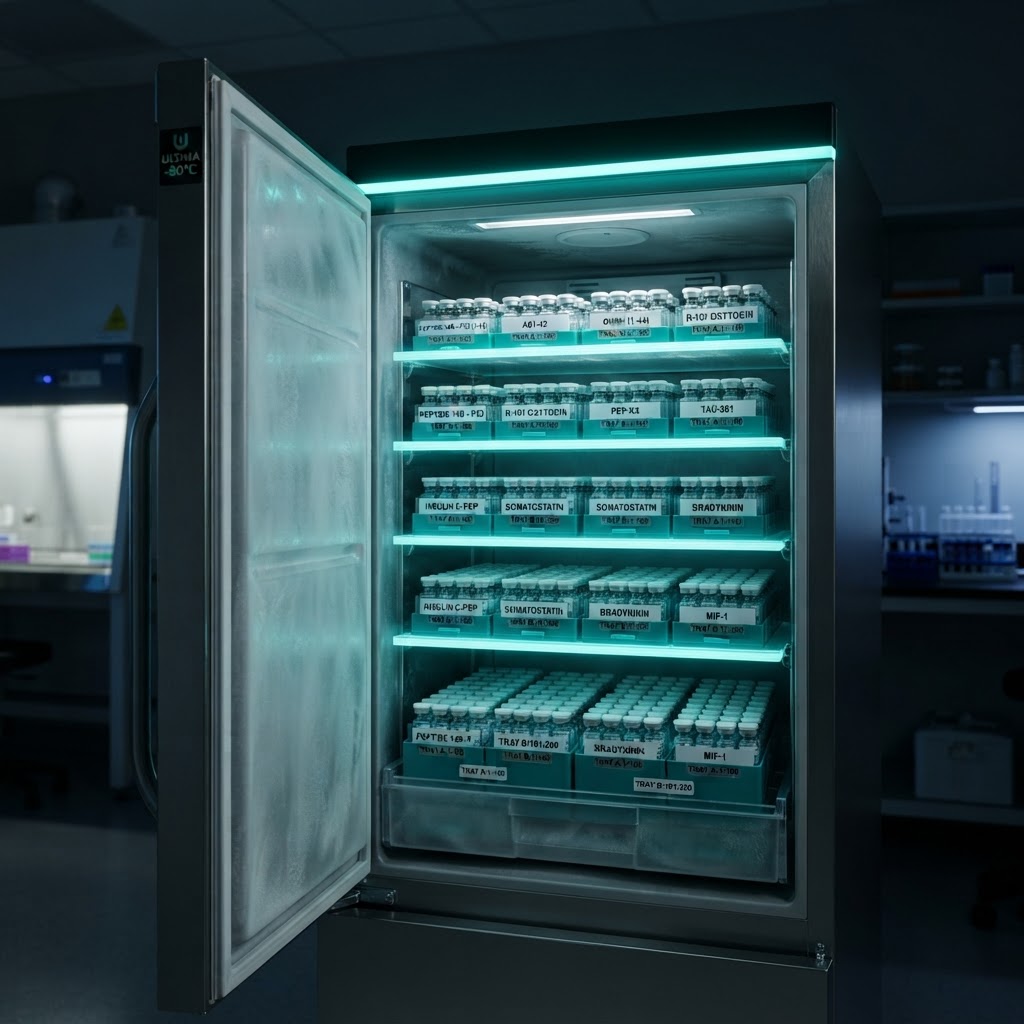
Table of Contents
- 01Is Improper Storage Silently Destroying Your Research Peptides?
- 02What Are Lyophilized and Liquid Peptides?
- 03How Does Peptide Degradation Work?
- 04What the Research Says About Peptide Stability
- 05Peptide Storage Best Practices: A Protocol-Level Guide
- 06Conclusion: Storage Is Part of Your Research Protocol
Is Improper Storage Silently Destroying Your Research Peptides?
Studies suggest that improperly stored peptides can lose up to 50% or more of their bioactive potency within just a few weeks — sometimes days. For research professionals investing in premium compounds, that's not just a financial loss; it's a direct threat to the integrity and reproducibility of your work. Whether you're working with growth hormone-releasing peptides, melanocortin analogs, or tissue-repair sequences, understanding peptide storage best practices is as fundamental as understanding mechanism of action.
In this guide, we'll break down the critical differences between storing lyophilized (freeze-dried) and liquid (reconstituted) peptides, outline the environmental enemies of peptide stability, and give you a clear, actionable protocol to protect your research investment from the moment a vial arrives at your lab.
What Are Lyophilized and Liquid Peptides?
Before diving into storage protocols, it's worth clarifying what these two forms actually are — because the physical state of a peptide fundamentally determines how it should be handled and stored.
Lyophilized peptides are produced through a freeze-drying process in which water is removed from a frozen peptide solution under vacuum. The result is a dry, often fluffy or cake-like powder that is significantly more stable than its liquid counterpart. This is the form in which most research-grade peptides are shipped and sold, including products from Biologix Supply's catalog.
Liquid (reconstituted) peptides are lyophilized peptides that have been dissolved in a suitable solvent — most commonly bacteriostatic water, sterile water, or acetic acid solution — in preparation for research use. Once reconstituted, peptides become far more susceptible to degradation, making proper storage even more critical.
How Does Peptide Degradation Work?
To appreciate why storage conditions matter so much, researchers need to understand the mechanisms by which peptides degrade. Peptides are short chains of amino acids linked by peptide bonds, and these bonds — along with the amino acid side chains — are vulnerable to several destructive processes:
- Hydrolysis: Water molecules attack and cleave peptide bonds, fragmenting the chain. This is dramatically accelerated in liquid form and at higher temperatures.
- Oxidation: Reactive oxygen species can modify amino acid residues, particularly methionine, cysteine, tryptophan, and histidine, altering the peptide's three-dimensional conformation and activity.
- Aggregation: Under certain conditions, peptide molecules clump together into insoluble aggregates, reducing bioavailability and functional activity in research models.
- Photodegradation: UV and visible light can catalyze oxidative damage and cause structural changes, particularly in peptides containing aromatic residues like tyrosine and phenylalanine.
- Enzymatic degradation: In liquid solutions, any microbial contamination introduces proteolytic enzymes that can rapidly break down peptide sequences.
Each of these pathways can be dramatically slowed — or nearly halted — by applying the correct peptide storage best practices for each form.
What the Research Says About Peptide Stability
Peer-reviewed pharmaceutical and biochemistry literature consistently reinforces several core principles of peptide stability. Research published in journals such as the Journal of Pharmaceutical Sciences and European Journal of Pharmaceutics and Biopharmaceutics highlights that:
- Lyophilized peptides stored at -20°C in a dry, dark environment can maintain structural integrity for 24 months or longer, depending on sequence composition.
- Reconstituted peptides stored at 4°C (refrigerator temperature) typically remain stable for 4 to 6 weeks, though this varies significantly by peptide sequence and solvent used.
- Reconstituted peptides stored at -20°C can be stable for 3 to 6 months, but freeze-thaw cycling is a major degradation risk and should be minimized.
- Peptides with disulfide bonds, such as some oxytocin analogs, show markedly accelerated degradation when exposed to oxygen, emphasizing the need for inert atmosphere storage or antioxidant buffers in sensitive cases.
The consensus is clear: temperature, moisture, light, and oxygen are the four primary variables that researchers must control to preserve peptide integrity.
Peptide Storage Best Practices: A Protocol-Level Guide
Storing Lyophilized Peptides
Lyophilized peptides are remarkably stable when stored correctly. Follow these peptide storage best practices for dry powder form:
- Temperature: Store at -20°C as a standard baseline. For long-term archival storage (beyond 12 months) or for particularly labile sequences, -80°C is preferred.
- Moisture protection: This is critical. Always allow vials to equilibrate to room temperature before opening to prevent condensation from forming on the cold peptide powder. Even brief moisture exposure can initiate hydrolysis. Consider using desiccant storage boxes for an additional layer of protection.
- Light exclusion: Store vials in amber glass containers or wrapped in aluminum foil, or in opaque freezer boxes. Avoid clear containers in lit freezers.
- Minimize freeze-thaw cycles: Even in lyophilized form, repeated temperature fluctuations can stress the molecular structure. Purchase in sizes appropriate for your research timeline to avoid unnecessary temperature cycling.
- Labeling: Always clearly label vials with compound name, lot number, receipt date, and expiration date. Undocumented storage is a reproducibility risk.
Storing Reconstituted (Liquid) Peptides
Once a peptide is reconstituted, the clock starts ticking. These peptide storage best practices apply to liquid-form compounds:
- Choose the right solvent: Most peptides dissolve best in bacteriostatic water (0.9% benzyl alcohol), which provides antimicrobial preservation and extends usable life. Some hydrophobic or aggregation-prone peptides may require dilute acetic acid (0.1–1%) or DMSO as a co-solvent. Always verify solubility recommendations for your specific compound.
- Short-term storage (days to weeks): Store reconstituted peptides at 4°C in a dedicated lab refrigerator. Use within 4 weeks for optimal potency, though some stable peptides may remain usable up to 6 weeks.
- Medium-term storage (weeks to months): Aliquot the reconstituted solution into single-use volumes before freezing at -20°C. This is the single most important step to prevent degradation from freeze-thaw cycling. Never refreeze a thawed aliquot.
- Oxygen minimization: Work quickly during reconstitution. For oxygen-sensitive peptides, consider using nitrogen-purged vials or working in a low-oxygen environment.
- Sterile technique: Always use sterile needles and syringes, and work in a clean environment. Microbial contamination introduces proteases that will rapidly degrade your compound.
- Avoid vigorous mixing: Swirl gently or roll the vial between your palms to dissolve powder. Vortexing or shaking can cause aggregation and mechanical degradation of delicate sequences.
Quick-Reference Storage Summary
- Lyophilized, unopened: -20°C to -80°C, dark, dry — up to 24+ months
- Reconstituted at 4°C: Refrigerator, dark — up to 4–6 weeks
- Reconstituted, aliquoted at -20°C: Freezer, dark, no re-freeze — up to 3–6 months
- Working solution (same day): Room temperature, protected from light — use within hours
Conclusion: Storage Is Part of Your Research Protocol
In the world of peptide research, compound quality doesn't end with synthesis purity — it's maintained or destroyed by every decision made post-delivery. Implementing rigorous peptide storage best practices is not administrative overhead; it is a core scientific discipline that directly impacts the validity of your experimental results.
The key takeaways are straightforward: keep lyophilized peptides cold, dry, and dark until use; reconstitute only what you need; aliquot before freezing liquid solutions; and never underestimate the destructive power of light, moisture, heat, and oxygen. With these protocols in place, you can have full confidence that the compound you're studying at week eight is functionally equivalent to the one you received on day one.
At Biologix Supply, every peptide in our catalog is manufactured to the highest research-grade standards and shipped lyophilized to ensure maximum stability in transit. Our team is committed to supporting not just the quality of the compound at the point of sale, but the integrity of your research from vial to experiment.
Disclaimer: All products offered by Biologix Supply are intended for laboratory research purposes only. They are not intended for human consumption, therapeutic use, veterinary use, or any application outside of controlled scientific research settings. These statements have not been evaluated by the FDA. Researchers are responsible for complying with all applicable laws and institutional regulations regarding the use of research compounds.
Biologix Supply Research Team
Expert research team specializing in peptide science and longevity compounds.