Understanding the Peptide Certificate of Analysis (COA) for Science
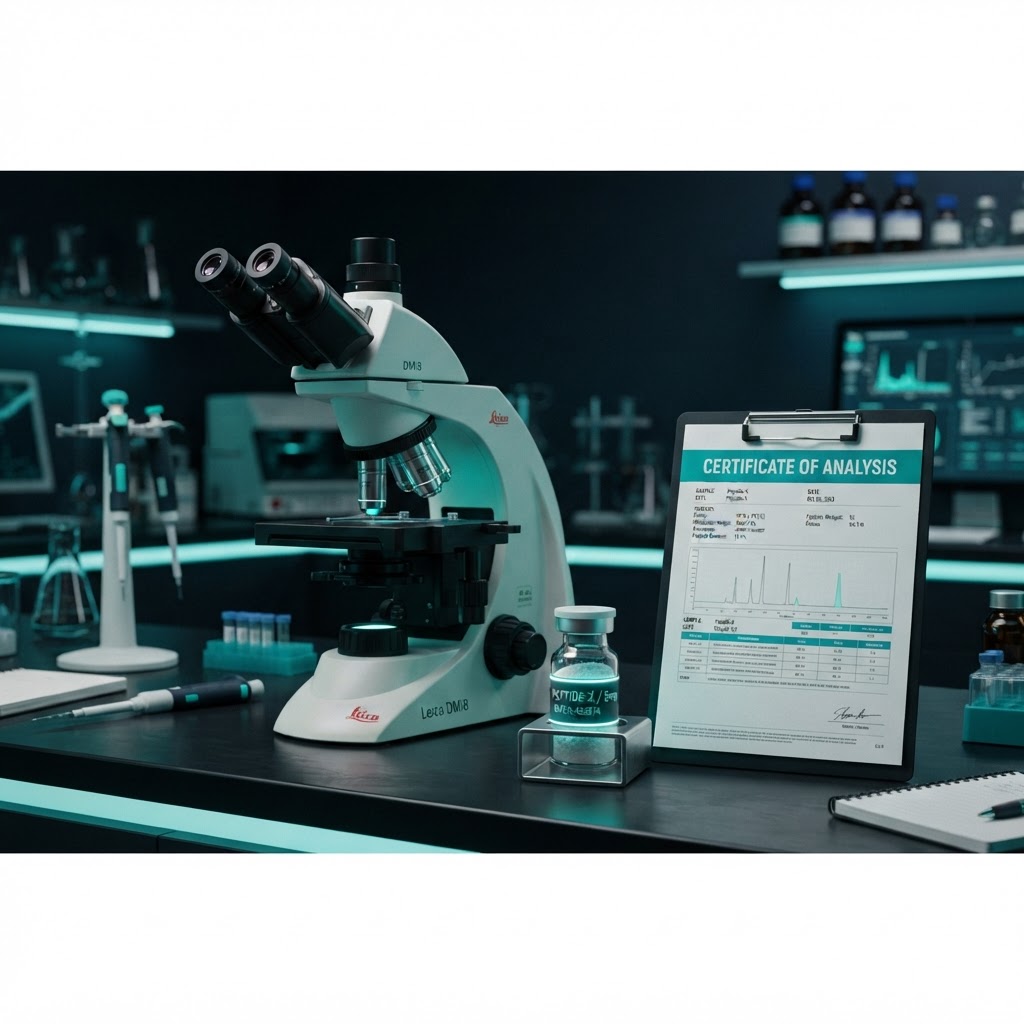
Table of Contents
The Critical Importance of Laboratory Standards
Did you know that the validity of your entire experimental study could hinge on a single document? For research professionals, sourcing peptides is more than a simple transaction; it is a critical step in maintaining data integrity. If the purity or sequence accuracy of your compound is compromised, your results become unreliable. This is where the peptide certificate of analysis COA becomes the cornerstone of scientific transparency.
What Is a Peptide Certificate of Analysis (COA)?
A peptide certificate of analysis (COA) is a formal document provided by a testing laboratory or manufacturer that outlines the quality and composition of a specific batch of peptides. It serves as a "birth certificate" for the compound, confirming that it has undergone rigorous analytical testing. Key metrics included in a standard COA are typically HPLC (High-Performance Liquid Chromatography) results for purity, Mass Spectrometry (MS) data for molecular weight confirmation, and often testing for heavy metal content or moisture levels.
How Does It Work?
The COA operates through a series of analytical benchmarks. First, HPLC determines the purity level of the peptide, typically expressed as a percentage. In research-grade peptides, scientists look for purity levels exceeding 98%. Second, Mass Spectrometry confirms the identity of the molecule by measuring the mass-to-charge ratio of ions, ensuring the sequence produced is the intended one. By comparing these lab-derived values against the theoretical molecular weight, researchers can be certain they are working with the correct chemical structure.
What the Research Says
Peer-reviewed literature consistently underscores that reagent quality is a frequent, yet overlooked, variable in failed replications. Studies regarding peptide synthesis emphasize that side-chain truncations or improper folding—often hidden in substandard products—can drastically alter the biological activity of the compound. Accessing a transparent peptide certificate of analysis COA allows scientists to identify potential contaminants that might inhibit receptors or cause off-target effects in cell-based assays, ensuring that the observations made in the lab are accurate reflections of the peptide's true potential.
Research Protocols & Dosing Notes
When incorporating a new peptide into your research protocols, standardizing the concentration is vital. Before performing serial dilutions or establishing dosing parameters, always verify the net peptide content provided on your COA. Often, the total weight of a lyophilized powder includes acetate or trifluoroacetate (TFA) salts and water. A COA will clarify the net peptide content versus the total gross weight, allowing for precise molar calculations. Always store your peptides according to the temperature conditions specified in the documentation to ensure the stability confirmed by the analysis remains intact throughout the study duration.
Conclusion
For the serious researcher, the peptide certificate of analysis (COA) is not merely a formality—it is a safeguard for your data and your reputation. By consistently requiring and reviewing a third-party or verified internal COA, you ensure that every variable in your experiment is controlled and reproducible. At Biologix Supply, we prioritize this level of transparency because we understand that your work demands nothing less than absolute precision.
Disclaimer: These products are for research purposes only. Not for human consumption.
Biologix Supply Research Team
Expert research team specializing in peptide science and longevity compounds.