Understanding the Peptide Certificate of Analysis (COA) for Research
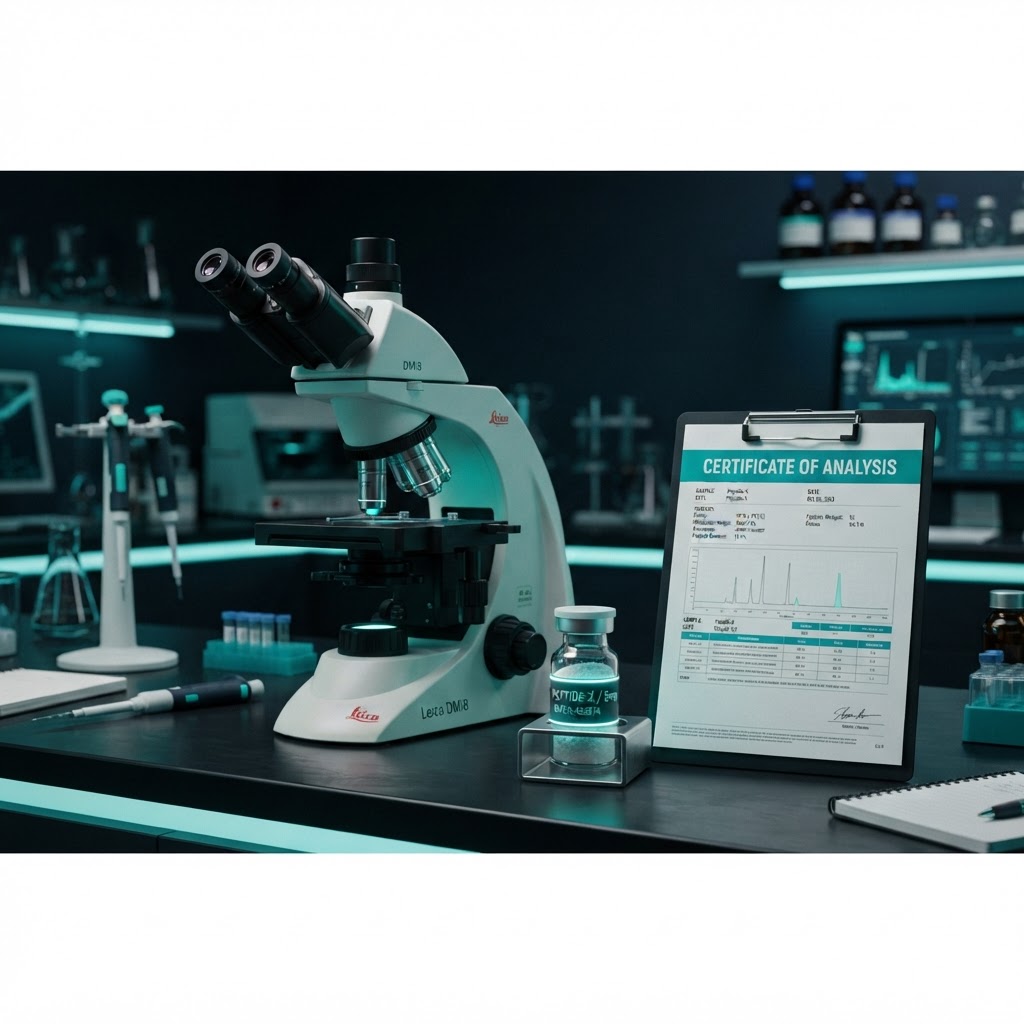
Table of Contents
The Foundation of Reproducible Science
Did you know that inconsistent research outcomes are frequently traced back to impure reagents? In experimental settings, the validity of your data hinges entirely on the quality and purity of the substances you use. For scientists and lead researchers, the peptide certificate of analysis (COA) is not just a piece of paperwork—it is the single most important document verifying the identity and integrity of your compounds.
What Is a Peptide Certificate of Analysis (COA)?
A peptide certificate of analysis (COA) is a formal document issued by a quality assurance laboratory that details the results of specific testing performed on a batch of chemical or biological material. When sourcing peptides for laboratory studies, the COA acts as a roadmap, confirming exactly what is in the vial. It typically includes data from high-performance liquid chromatography (HPLC) to verify purity and mass spectrometry (MS) to confirm molecular weight. Without a verified peptide certificate of analysis (COA), researchers are essentially working with an unknown variable, which undermines the scientific method.
How Does Quality Validation Work?
The process of verifying peptide quality is rigorous. First, the laboratory produces the peptide through solid-phase or liquid-phase synthesis. Once the crude peptide is obtained, it must undergo purification, usually via preparative HPLC. Following this, the batch is analyzed. The HPLC data on the COA provides a percentage representing the purity level—the higher the percentage, the fewer the contaminants. The mass spectrometry data acts as a 'fingerprint,' ensuring the amino acid sequence is correct. When reviewing your peptide certificate of analysis (COA), always look for these two metrics to ensure your experiment is protected from external variables.
What the Research Says
Scientific literature consistently emphasizes that trace impurities—such as residual solvents, truncated peptide sequences, or trifluoroacetic acid (TFA)—can drastically alter biological feedback in cell cultures and animal models. Recent studies in protein pharmacology suggest that even 5% impurity levels can lead to dose-dependent toxicity or unexpected pharmacological interactions. By insisting on a transparent peptide certificate of analysis (COA), researchers eliminate these confounding factors, ensuring that the results reported in studies are indicative of the peptide’s true potential rather than the presence of degradation products.
Research Protocols & Dosing Notes
When incorporating peptides into your research workflow, the COA also guides your dilution protocols. Because a certificate confirms the net peptide content versus the gross weight (which may include salts or water content), it allows for precise molar calculations. Researchers must adjust their stock solutions based on the net peptide weight to ensure consistent dosing across trial groups. Failure to account for these specific figures found on the certificate can lead to significant errors in potency and inconsistent research data across experimental cohorts.
Conclusion
In the high-stakes world of laboratory research, shortcuts are not an option. A peptide certificate of analysis (COA) provides the transparency and accountability required for peer-reviewed science. At Biologix Supply, we believe that rigorous testing is the backbone of discovery. Always verify your documentation to ensure that your findings are built on a solid foundation of accuracy and purity. By prioritizing the validity provided by a comprehensive COA, you safeguard your experiments and advance the standards of peptide research.
Disclaimer: These products are for research purposes only. Not for human consumption.
Biologix Supply Research Team
Expert research team specializing in peptide science and longevity compounds.