GHK-Cu Skin Regeneration: Scientific Overview and Mechanisms
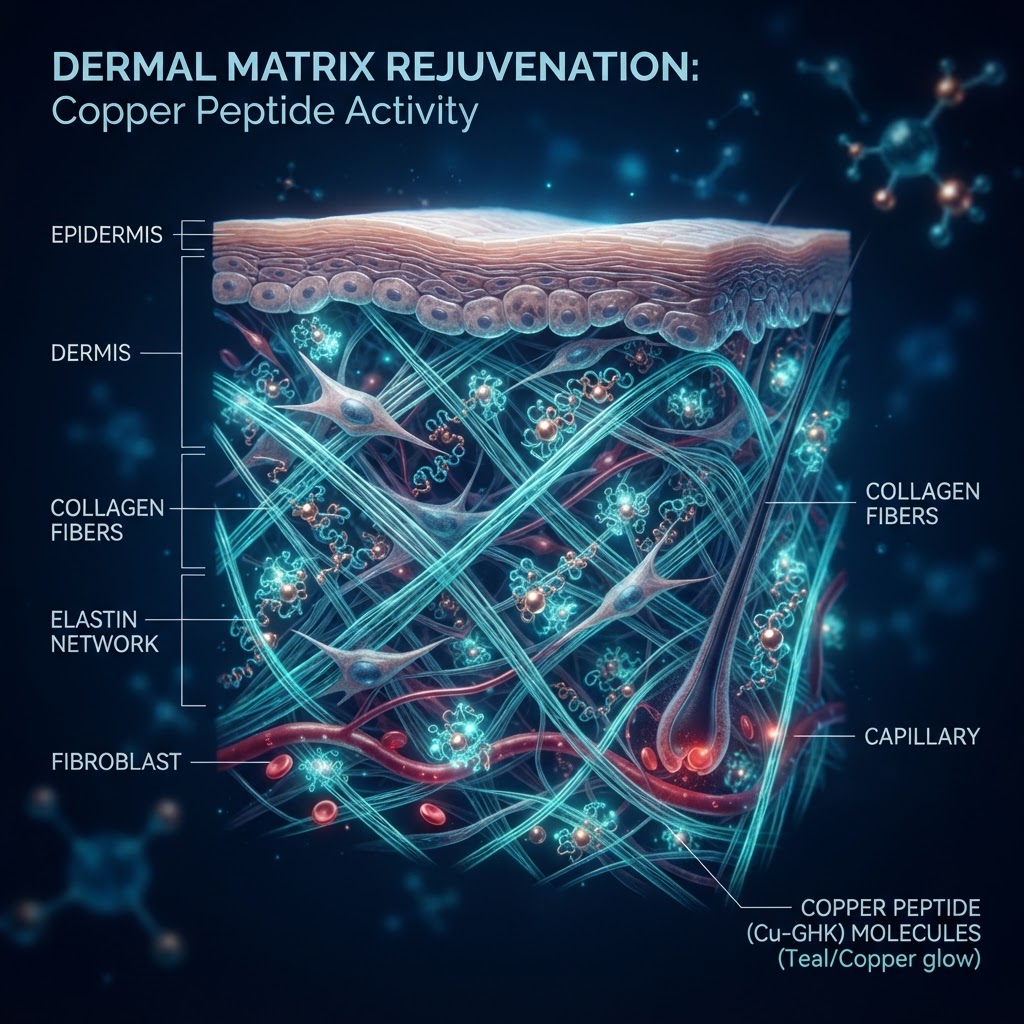
Table of Contents
The Science of Cellular Repair
Did you know that the concentration of the tripeptide GHK in human plasma drops by more than 60% between the ages of 20 and 60? This significant decline in endogenous levels has positioned GHK-Cu as a primary subject in the study of tissue repair and cellular rejuvenation. As researchers seek to unlock new pathways for accelerating tissue recovery, the role of GHK-Cu skin regeneration has become a focal point of intense scientific inquiry.
What Is GHK-Cu?
GHK-Cu, or Glycyl-L-histidyl-L-lysine-copper, is a naturally occurring copper-binding tripeptide found in human plasma, saliva, and urine. Discovered by Dr. Loren Pickart in 1973, it is known for its ability to bind specifically to copper ions, forming a complex that plays a critical role in human physiology. In the context of dermatological research, it is frequently studied for its pleiotropic effects, ranging from stimulating collagen synthesis to modulating inflammatory responses in wounded tissue.
How Does It Work?
The mechanism of GHK-Cu skin regeneration is multifaceted, primarily involving the modulation of gene expression. When introduced to damaged tissue models, GHK-Cu appears to act as a signaling molecule that activates pathways essential for healing:
- Collagen Production: GHK-Cu is known to stimulate the production of collagen and elastin in fibroblasts, the primary cells responsible for the structural integrity of the skin.
- Angiogenesis: By promoting the formation of new blood vessels, GHK-Cu improves the blood supply to injured sites, facilitating faster nutrient delivery and waste removal.
- Modulation of Inflammation: The peptide appears to exert anti-inflammatory effects by reducing the secretion of pro-inflammatory cytokines, which helps in transitioning the wound environment toward the proliferative phase of healing.
- Glycosaminoglycan Synthesis: It encourages the synthesis of hyaluronic acid and other components of the extracellular matrix, which are vital for skin hydration and repair.
What the Research Says
Extensive in vitro and in vivo studies have consistently highlighted the efficacy of copper peptides in wound healing. Research models have demonstrated that GHK-Cu accelerates the healing process in ischemic wounds and full-thickness burns. Furthermore, data indicates that the peptide assists in the remodeling of scar tissue by balancing the expression of matrix metalloproteinases (MMPs) and their inhibitors (TIMPs). For researchers focused on GHK-Cu skin regeneration, the existing literature suggests that its ability to reset gene expression in senescent cells is what makes it a uniquely potent tool in regenerative medicine.
Research Protocols & Dosing Notes
In laboratory and clinical research settings, GHK-Cu is often investigated in topical delivery systems or through controlled delivery vehicles to ensure stability and skin penetration. Researchers typically note that copper peptides are highly sensitive to pH levels; therefore, maintaining an optimal environment is critical for experimental consistency. Dosage in research models varies significantly based on the intended site of administration and the density of the cellular target, with concentrations often ranging from 0.01% to 0.5% in experimental topical applications. Due to the high biological activity of the peptide, rigorous attention to purity and sourcing is essential for achieving reproducible results in high-level research.
Conclusion
The study of GHK-Cu skin regeneration offers a promising frontier for regenerative medicine. By leveraging the body's intrinsic mechanisms for repair, researchers continue to uncover the deep-seated benefits of this copper-binding peptide. As our understanding of its genomic and cellular influence grows, GHK-Cu remains an essential subject of study for those looking to advance the science of wound care and skin longevity.
Disclaimer: These products are for research purposes only. Not for human consumption.
Biologix Supply Research Team
Expert research team specializing in peptide science and longevity compounds.